
Executives rarely struggle because they lack project information. The bigger challenge is separating meaningful signals from operational noise when dozens of initiatives compete for resources, funding, and leadership attention. A project team may produce detailed schedules, issue logs, and status updates every week, yet senior leaders may still lack a clear understanding of where action is required.
An effective executive project dashboard solves this problem by transforming project data into decision support. It does not exist to display every task, milestone, or activity happening across the organization. Instead, it highlights the conditions that influence business outcomes, including emerging risks, resource constraints, unresolved decisions, and operational bottlenecks. A well-designed dashboard helps executives understand what needs attention, who needs to act, and what consequences may occur if decisions are delayed.
Traditional project reports are usually designed for people responsible for execution. Project managers and team members need detailed information about tasks, dependencies, schedules, and daily challenges. Executives have a different responsibility. They are responsible for making choices about priorities, investments, resources, and strategic direction rather than managing individual activities.
This difference explains why many organizations have extensive reporting processes but still struggle with executive visibility. A project may appear healthy because it is meeting current milestones, yet hidden problems may exist behind the numbers. A supplier delay, unresolved security issue, shortage of specialized employees, or pending approval can create future problems that are not obvious in a standard status report.
The problem is rarely a shortage of data; it is the difficulty of identifying which information represents a meaningful business signal. An executive dashboard should help leaders answer practical questions: Which projects require attention? Which risks could affect strategic goals? Which decisions cannot wait? Which resource conflicts may slow multiple initiatives?
The Project Management Institute’s portfolio management standards emphasize aligning initiatives with organizational strategy while balancing available resources, priorities, and risks. An executive dashboard supports this purpose by providing leaders with a portfolio-level view instead of isolated project updates.
Many organizations make the mistake of starting with available data rather than business decisions. They collect every possible metric and then attempt to create a dashboard around that information. The result is often a crowded display that contains plenty of data but provides limited guidance.
A stronger approach begins by identifying the decisions executives need to make. For example, leaders may need to determine whether a project should receive additional funding, whether resources should be moved between initiatives, whether a timeline should change, or whether a known risk should be accepted. Every dashboard element should support one of these decisions.
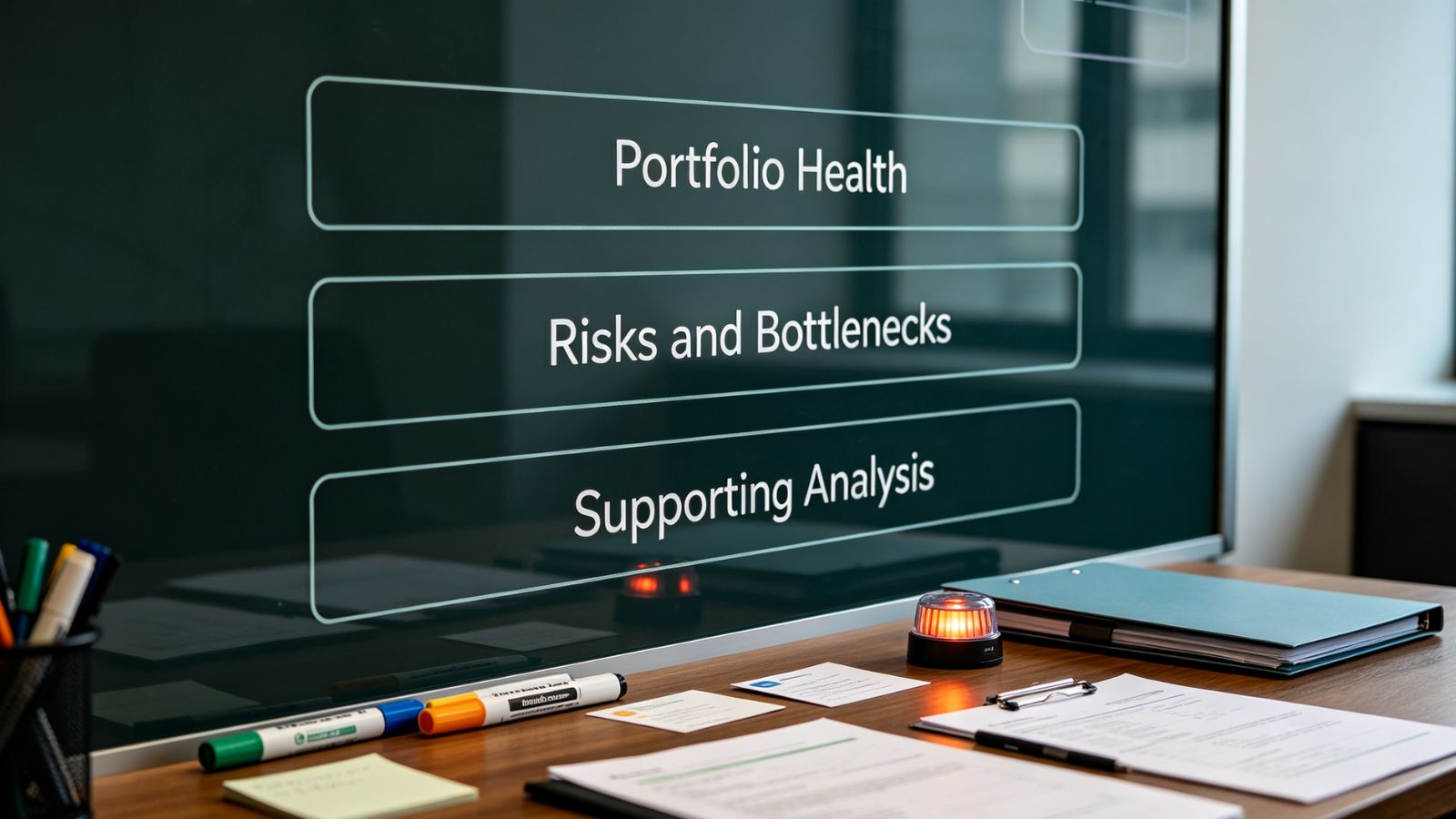
A practical executive dashboard can follow a three-layer structure.
Layer 1: Portfolio Health Overview
This layer provides a quick view of major initiatives, strategic alignment, overall project health, and significant changes. It answers the question: “What is the current condition of the project portfolio?”
Layer 2: Risks, Bottlenecks, and Decision Points
This layer highlights high-impact risks, resource constraints, dependencies, and decisions requiring leadership attention. It answers the question: “Where could progress be affected, and what action is needed?”
Layer 3: Supporting Analysis
This layer provides additional context, such as milestone trends, budget details, resource capacity information, and project-specific analysis. It answers the question: “What information supports the decision?”
This structure prevents a common mistake: trying to create one dashboard that serves executives, project managers, and delivery teams equally. Different audiences require different levels of detail. Executive dashboards should optimize for decision speed, not information volume.
A useful dashboard combines several categories of information that help leaders understand both current performance and future challenges. The specific metrics will vary depending on the organization, but the most valuable dashboards usually focus on project health, risks, resources, and decisions.
Basic health indicators provide executives with a quick understanding of portfolio conditions. Common examples include schedule performance, budget status, milestone progress, and scope changes. These measurements create a starting point, but they become more valuable when connected to business impact.
For example, a project that is slightly behind schedule may not require executive attention if the delay has no effect on strategic goals. Another project that appears on schedule may require immediate intervention if it depends on an unresolved decision or a limited resource that will become unavailable later.
Useful executive dashboard metrics often include:
Milestones at risk: Shows potential delivery problems before deadlines are missed.
Budget variance: Identifies projects that may require financial decisions.
Critical resource utilization: Reveals capacity problems affecting multiple initiatives.
High-impact open risks: Highlights issues requiring escalation.
Pending decisions: Shows where leadership action may remove blockers.
The goal is not to display every measurement available. The goal is to provide enough context for leaders to understand what requires attention.
Risk visibility is one of the most important functions of an executive dashboard. Leaders need to know not only which problems exist but also how those problems could affect business outcomes.
A useful risk section may include:
The risk description
Business impact
Risk owner
Expected timing
Mitigation status
Required executive action
However, an executive dashboard should not become a replacement for a detailed project issue register. Executives usually do not need every minor problem. They need visibility into issues that could affect customers, financial objectives, compliance requirements, or major strategic initiatives.
The strongest dashboards connect risks with decisions. If a project is delayed because several initiatives require the same technical specialists, the dashboard should highlight the resource conflict. If additional funding may be needed, the dashboard should identify the decision deadline and potential consequences of waiting.
Bottlenecks often appear when organizations manage several projects at the same time. A limited technology team, delayed approval process, unavailable supplier, or overloaded specialist can slow multiple initiatives simultaneously. These problems are difficult to identify when each project is reviewed separately.
For example, a company may be launching a new customer platform while upgrading internal infrastructure and improving cybersecurity controls. Each project may have a reasonable timeline, but all three may depend on the same infrastructure engineers. Without a portfolio-level view, leadership may discover the capacity problem only after deadlines begin to slip.
Executive dashboards can reveal these issues by showing dependencies and resource pressure across projects. A useful dashboard does not simply report that a project is delayed. It helps explain why the delay is happening and whether the issue requires executive involvement.
The purpose of identifying bottlenecks is not to eliminate every constraint. Organizations naturally operate with limited resources. The goal is to identify constraints early enough that leaders still have meaningful choices, such as changing priorities, adjusting timelines, reallocating resources, or accepting a controlled level of risk.
One of the most valuable features of an executive dashboard is making important decisions visible before they become urgent problems. Many project challenges are not caused by a lack of information. They happen because decisions are delayed or ownership is unclear.
A decision section of the dashboard may include:
The decision required
Responsible executive owner
Deadline for action
Available options
Expected impact of delay
For example, a technology transformation project may require a decision about whether to hire external specialists or extend the delivery timeline. A standard status report may only show that the project is facing a staffing risk. An executive dashboard should make the decision requirement clear.
This approach changes the role of reporting. Instead of asking executives to interpret problems from raw information, the dashboard presents situations where leadership involvement can directly influence outcomes.
One common mistake is creating dashboards that contain too many measurements. A dashboard filled with charts, colors, and indicators may appear sophisticated, but excessive information can make important signals harder to recognize. A useful dashboard prioritizes clarity over completeness.
Another mistake is treating dashboards as passive reporting documents. If a dashboard only shows completed work and current status, it becomes another weekly update rather than a management tool. The most effective dashboards focus on trends, decisions, and risks that require attention.
Organizations should also avoid relying entirely on automated metrics. Data can show that a milestone has slipped or that resource demand has increased, but it may not explain the business reason behind the change. Human judgment remains necessary to interpret information and determine the right response.
An executive project dashboard should evolve as organizational priorities change. The metrics that matter during a digital transformation may differ from those needed during a cost reduction program, operational expansion, or regulatory initiative.
Regular dashboard reviews help ensure that information remains useful. Leadership teams should periodically evaluate whether current metrics still support decision-making or whether new risks and priorities require additional visibility.
The best dashboards are not necessarily the most detailed. They are the ones that reduce uncertainty and help leaders focus attention where it creates the greatest impact. A dashboard becomes valuable when it improves the quality and speed of decisions, not when it simply displays the largest amount of information.
Building executive project dashboards that highlight risks, bottlenecks, and decision points requires more than collecting project data. The real challenge is identifying which information helps leaders understand uncertainty, evaluate trade-offs, and take action at the right time.
A strong executive dashboard connects project performance with business decisions. By making risks visible, exposing bottlenecks, and clarifying decision ownership, organizations can manage complex project portfolios more effectively and respond to challenges before they become major operational problems.