
Generative AI has changed the drafting stage of business communication. Marketing teams can produce a first draft quickly, support teams can organize large amounts of text, and internal teams can turn rough notes into readable documents with far less manual work. The speed is useful, but it creates a separate problem: a polished sentence is not necessarily a verified sentence.
Language models can produce claims that sound authoritative even when the underlying information is incomplete, outdated, or incorrect. A generated statistic may look precise without having a reliable source behind it. A summary of a regulation may leave out an important exception. A citation can appear legitimate while pointing to a source that does not support the statement at all.
That changes the role of editorial review. The question is no longer simply whether an AI-assisted document reads well. Reviewers also need to determine which claims require verification, where the underlying evidence comes from, and who is responsible for approving the final version.
One of the practical difficulties with AI-assisted writing is that errors do not always look like errors. Awkward wording may attract an editor's attention, but a confident and well-structured paragraph can pass a quick review even when one of its dates, figures, names, or citations is wrong.
For that reason, stylistic quality should be treated separately from factual accuracy. A useful review process begins with the assumption that generated claims are drafts, not evidence. The reviewer then determines which statements can be accepted, which need a source check, and which should be removed.
This does not mean every sentence needs the same level of scrutiny. The appropriate review depends on what the content says, who will use it, and what could happen if an important claim is wrong.
A practical quality-control system can divide AI-assisted content into different review levels. The exact categories will vary by organization, but the principle is straightforward: the potential consequences of an error should determine how much verification the document receives.
Tier 1: Low-risk internal material: Draft outlines, brainstorming notes, or preliminary meeting summaries may need a basic human review for clarity, intent, and obvious factual problems. Formal source verification may not be necessary when the material is strictly internal and will not be used to make important decisions.
Tier 2: General external content: Blog articles, product explanations, newsletters, and marketing materials should receive normal editorial review. Claims involving statistics, product specifications, dates, named organizations, and external references should be checked before publication.
Tier 3: High-impact or regulated content: Financial information, legal material, healthcare information, compliance documentation, and other content where inaccuracies could materially affect people or organizations should receive a more rigorous review. Depending on the subject, that may include primary-source verification and review by an appropriately qualified subject-matter expert.
The purpose of risk tiers is not to create unnecessary bureaucracy. It is to prevent a low-risk internal draft from receiving the same review process as a document that could influence a financial, legal, health, or regulatory decision.

A common mistake in AI-assisted editing is to check whether a citation exists without checking whether it actually supports the sentence around it.
A stronger process works at the claim level. If a document says that a regulation changed on a particular date, the reviewer should locate the relevant official source and confirm the date. If the document contains a market statistic, the reviewer should identify the underlying report or dataset and confirm that the number has been represented correctly.
The model's own explanation is not the evidence.
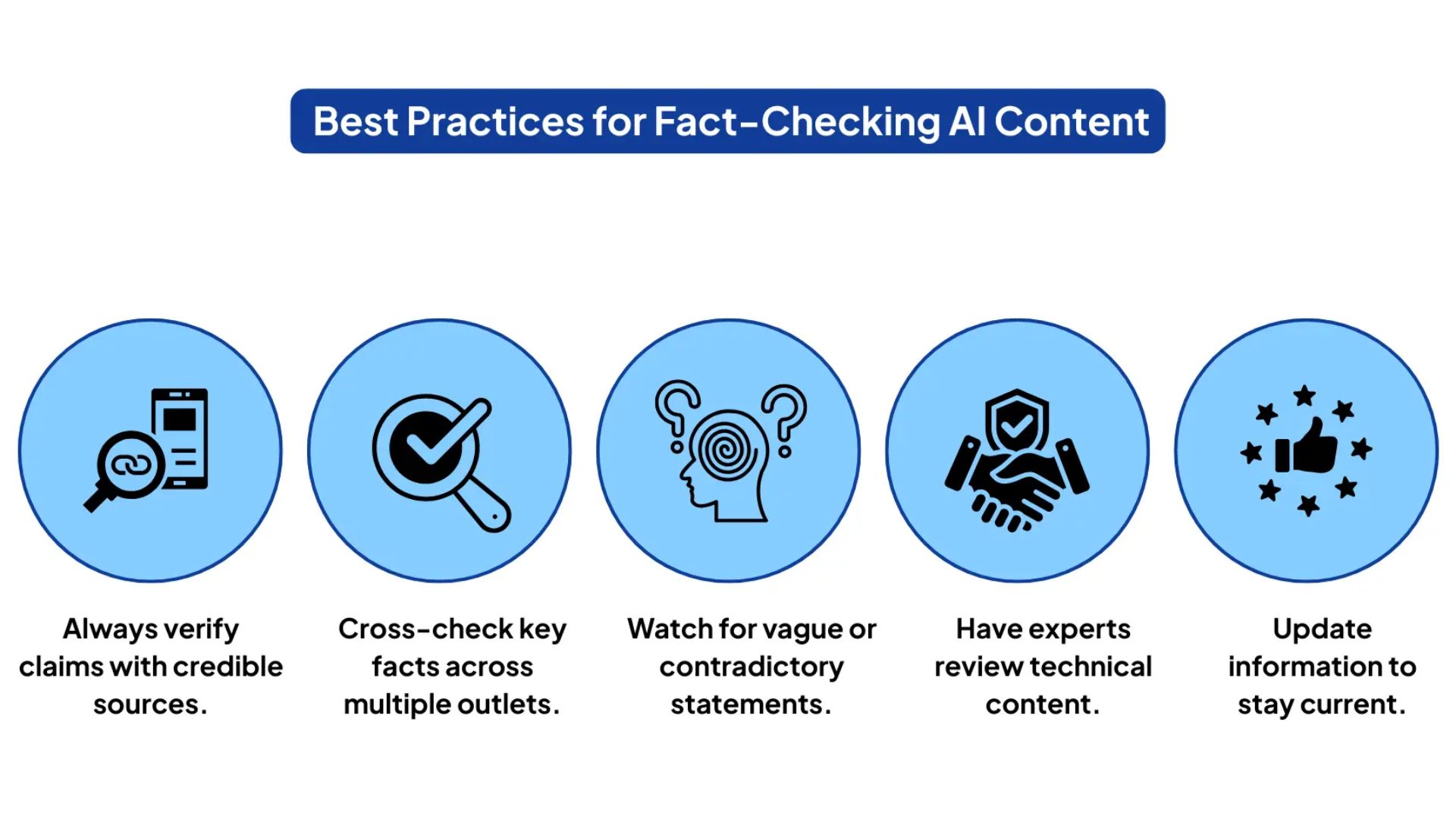
Trace important claims to authoritative sources: Statistics, regulatory requirements, historical dates, technical specifications, and other material claims should be checked against the strongest available source. Depending on the subject, this may be a government publication, official documentation, original research, corporate record, or another authoritative source.
Do not treat model-generated citations as proof: A language model can produce a citation that looks convincing without establishing that the source exists or supports the claim. Reviewers should open and inspect the underlying source rather than accepting the reference at face value.
Keep critical numbers tied to source systems: Financial figures, inventory counts, transaction totals, customer metrics, and other operational numbers should come from verified databases, reports, or other controlled sources. A model should not be expected to reconstruct important figures from memory.
Check dates and versions: Product specifications, policies, regulations, software documentation, and other time-sensitive material can change. A fact that was correct when an earlier document was published may no longer be correct.
Check consistency across documents: Names, product descriptions, terminology, policy references, and technical specifications should match the organization's approved documentation.
Remove unsupported claims: When an important statement cannot be verified through a reliable source, removing it is safer than asking the model to fill the gap with another generated answer.
This process is particularly useful for documents that combine information from several sources. One incorrect number or outdated policy reference can undermine an otherwise accurate article.
Not every useful part of an AI-generated document is a factual claim. Some sections summarize information, explain a concept, or organize material that has already been verified.
A reviewer can therefore separate the document into at least three categories:
Source-backed facts: Information that can be checked against an external or internal authoritative source.
Derived analysis: Conclusions or comparisons based on verified information.
Generated wording: Language used to explain or organize the material.
The distinction helps reviewers focus their effort. A sentence describing the implications of two verified facts may require editorial judgment rather than a separate citation, while a precise statistic should generally have a traceable source.
For business content, maintaining this distinction also makes later corrections easier. When a source changes, editors can identify which statements depend on it instead of reviewing the entire document from scratch.
Some business content carries greater consequences when it is wrong. This includes material related to financial decisions, healthcare, insurance, legal matters, compliance requirements, employment rights, or other subjects where readers may rely on the information when making consequential decisions.
The appropriate response is not necessarily to prohibit AI-assisted drafting. Instead, the review process should become more rigorous.
Keep general information separate from personalized advice: AI-assisted material should not present generalized information as though it were a recommendation tailored to a particular person's financial, medical, tax, or legal circumstances.
Use qualified human review when appropriate: Content that requires specialized judgment should be reviewed by someone with appropriate subject-matter expertise before publication.
Check jurisdiction and scope: Laws, regulations, professional requirements, and other rules can differ by location and change over time. A statement that applies in one jurisdiction should not automatically be presented as a universal rule.
State meaningful limitations: When exceptions, eligibility requirements, dates, or jurisdictional boundaries materially affect the information, those limitations should be visible rather than buried or omitted.
Escalate unresolved uncertainty: If a reviewer cannot establish whether an important claim is correct, the document should not be published as though the claim were settled.
These safeguards make the human reviewer's role explicit. AI can assist with drafting and organization, but responsibility for the published material remains with the organization and its designated reviewers.
A quality-control process works only when someone owns the final decision. Simply adding a rule that says “AI output must be checked” does not explain who performs the check, what evidence is acceptable, or what happens when a reviewer finds a problem.
Each published document should therefore have a clear human owner. That person may be an editor, subject-matter specialist, communications lead, compliance reviewer, or another appropriately assigned role.
Assign ownership: Every externally published AI-assisted document should have a named person or defined role responsible for final approval.
Maintain verification records: For high-impact material, organizations can retain the sources used to verify important claims and record when the review occurred.
Log recurring errors: When reviewers identify fabricated citations, incorrect figures, outdated information, or other recurring problems, the organization can use those examples to improve prompts, source-selection rules, and editorial checklists.
Give reviewers authority to stop publication: Editors and subject-matter reviewers should be able to delay publication when a material claim cannot be verified, even when there is pressure to publish.
Review the process itself: Quality control should evolve as the organization learns which types of AI output are reliable and which repeatedly require correction.
This turns fact-checking from an informal final glance into a repeatable part of the publishing workflow.
A simple workflow can make the process easier to apply consistently.
First, identify the document's risk level and intended audience. Next, mark claims that contain numbers, dates, regulations, technical specifications, quotations, or other information that can be independently checked. Verify those claims against appropriate sources rather than relying on the model's explanation.
After factual verification, review the document for consistency, unsupported conclusions, missing qualifications, and statements that may be interpreted more broadly than the evidence allows. High-impact material should then receive any additional specialist or compliance review required by the organization.
Only after those steps should the document move to final copy editing and publication.
The order matters. Polishing an incorrect claim does not make the claim more reliable.

AI can make the drafting stage of business publishing considerably faster, but it does not remove the need for editorial judgment. A well-written paragraph can still contain an incorrect number, an outdated rule, or a citation that does not support the statement being made.
A stronger quality-control system separates writing quality from factual accuracy, assigns different review standards to different levels of risk, verifies important claims against authoritative sources, and gives a clearly identified human reviewer responsibility for the final version.
The result is not simply cleaner AI-assisted writing. It is a publishing process in which generated material is treated as a starting point, evidence is checked independently, and important claims have a clear path back to a reliable source.