
Large projects become challenging when the connections between goals, teams, decisions, and timelines are difficult to see. A company launching a new product, replacing a major business system, expanding into new locations, or changing internal operations may have hundreds of activities happening at the same time. The problem is rarely that teams do not know how to work. The problem is that people often lack a shared understanding of how individual efforts contribute to the final outcome.
Project decomposition solves this problem by creating a structure that connects strategy with execution. Instead of managing a large initiative as one overwhelming collection of tasks, project leaders break it into logical components: workstreams that organize areas of responsibility, milestones that mark meaningful progress, dependencies that reveal relationships between activities, and deliverables that define expected results. This approach is closely related to the Work Breakdown Structure (WBS), a project management practice used to organize total project scope into manageable components and deliverables.
The goal of decomposition is not to create more paperwork. A useful project structure helps teams understand ownership, make better decisions, and identify risks earlier. When a complex project is divided correctly, leaders can see where attention is needed while teams can focus on their responsibilities without losing sight of the overall objective.
The most effective project decomposition begins with the question: “What does success look like?” Many teams start planning by creating task lists because tasks feel measurable. They schedule meetings, assign resources, and build timelines before fully defining the result they are trying to achieve. This often creates a situation where teams complete many activities but later discover that the project scope, priorities, or expected outcomes were not clearly understood.
A better approach starts with the business outcome. For example, imagine a company replacing its customer support platform. The project is not successful simply because new software has been installed. The intended outcome may be faster response times, better customer visibility, and a more consistent support process. Once that outcome is defined, the project team can determine the major areas of work required to achieve it, including system configuration, data migration, workflow redesign, employee training, and performance tracking.
Outcome-based decomposition also helps control scope. Large projects frequently receive additional requests during execution, and many of these requests may appear useful. However, not every useful idea belongs inside the current initiative. A clear definition of success gives project leaders a practical way to evaluate whether new requests support the original objective or create unnecessary complexity.
This approach improves communication across different levels of an organization. Executives usually focus on business impact, while project teams manage detailed activities. Connecting tasks back to outcomes creates a shared language between decision-makers and those responsible for execution.
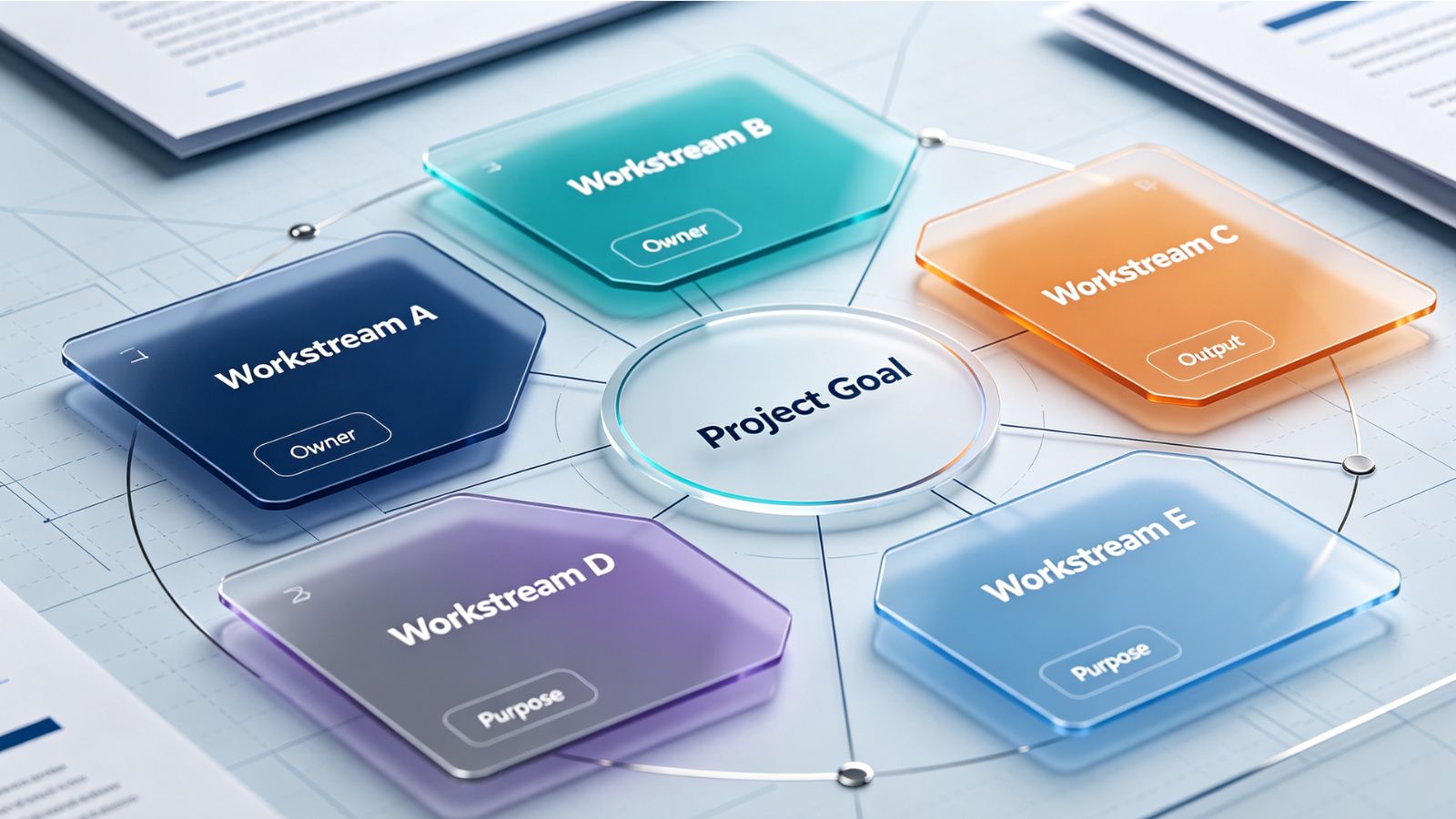
Workstreams are major areas of coordinated activity within a larger project. They help divide responsibility by grouping related work that contributes to the same objective. A well-designed workstream normally has a clear purpose, an accountable owner, defined outputs, and a connection to the broader project goal.
The strongest workstreams are usually organized around outcomes rather than department names. For example, a company opening a new regional office might create workstreams for facilities preparation, technology readiness, employee transition, vendor coordination, and communications. These categories reflect what must be achieved rather than simply separating work according to internal reporting structures.
Poorly designed workstreams create two common problems. When there are too few workstreams, important responsibilities may disappear inside broad categories. When there are too many, coordination becomes difficult because teams spend excessive time managing boundaries between groups. The right level of decomposition depends on project size, risk, and the number of stakeholders involved.
Workstreams also make accountability clearer. In complex initiatives, delays often happen because everyone assumes another team owns a critical activity. A clearly assigned workstream owner helps ensure that important decisions, deliverables, and risks have someone responsible for moving them forward.
Workstreams provide a high-level view of ownership, but large projects often need a more detailed framework for defining the actual scope of work. A Work Breakdown Structure (WBS) organizes project scope by breaking major deliverables into smaller components that can be planned, estimated, tracked, and managed. PMI describes WBS as a deliverable-oriented hierarchical decomposition of the work required to accomplish project objectives and create required deliverables.
The relationship between workstreams and WBS is important. A workstream explains who is responsible for a major area of the project, while the WBS explains what must be produced within that area. For example, a technology workstream in a digital transformation project may contain WBS components such as system configuration, integration testing, security review, user acceptance testing, and deployment preparation.
A common mistake is assuming that more detail automatically creates better planning. Excessive breakdown can make project plans difficult to maintain because teams spend more time updating schedules than managing outcomes. The purpose of decomposition is to reach a practical level where responsibilities, risks, estimates, and deliverables are clear enough to support execution.
A strong WBS creates a connection between strategic objectives and daily work. Team members can understand how their contribution fits into the larger initiative, while project leaders gain confidence that important areas of scope have been considered.
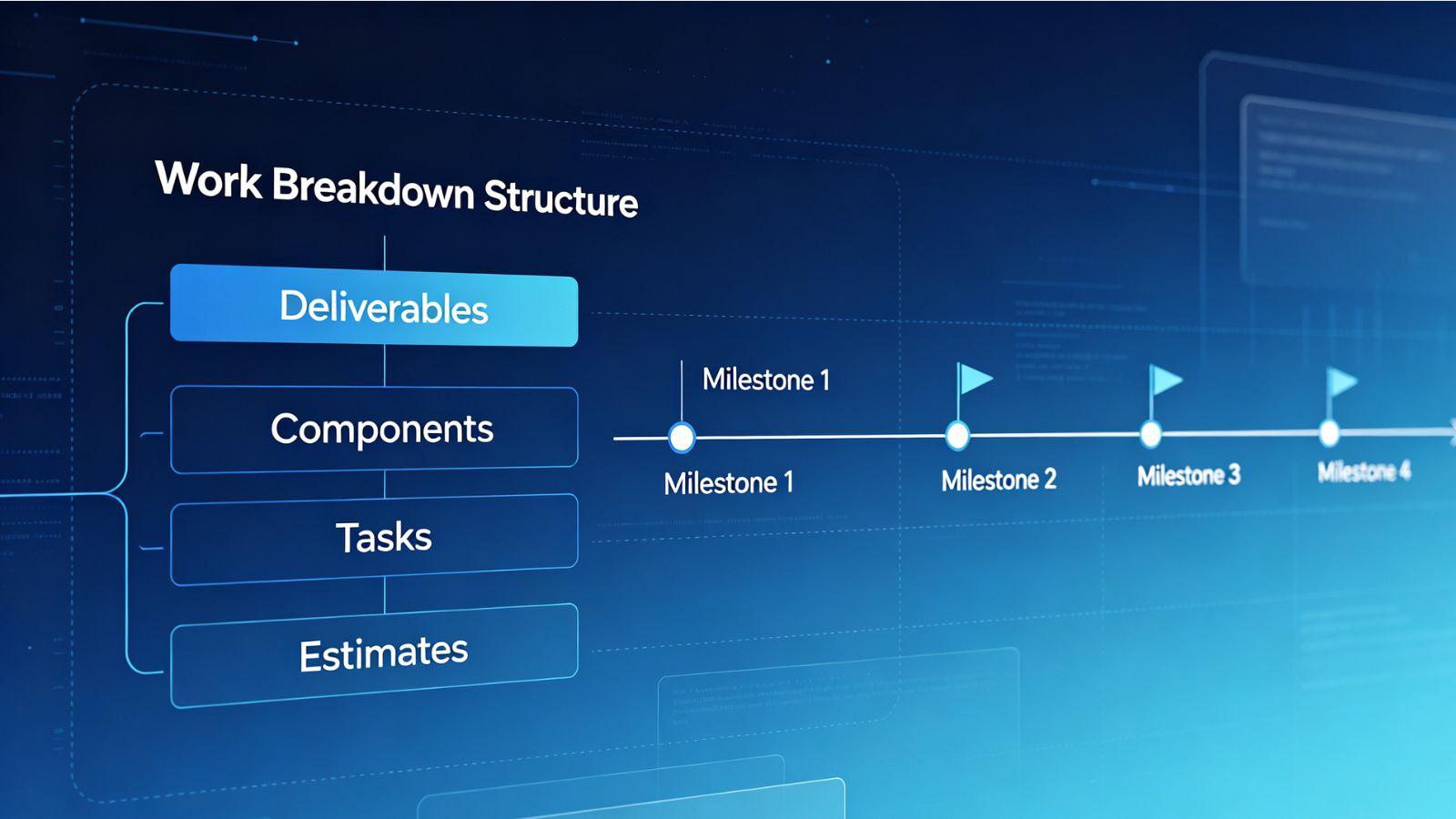
Milestones represent important points in a project where progress can be evaluated. Unlike ordinary tasks, milestones describe significant achievements, approvals, or readiness conditions. They provide stakeholders with a clearer picture of project status without requiring them to review every individual activity.
Effective milestones focus on outcomes rather than actions. “Complete security approval” communicates more value than “schedule security meetings” because it identifies the condition that must be achieved. Similarly, “employees are prepared for system rollout” is more meaningful than simply tracking whether training invitations were sent.
Milestones also create natural decision points. Before moving into a new project phase, teams can review whether assumptions remain valid, risks are controlled, and required deliverables are complete. This prevents organizations from continuing forward with unrealistic plans simply because significant time and resources have already been invested.
However, milestones should be used carefully. If every small activity becomes a milestone, the project loses visibility because important achievements become mixed with routine tasks. Effective milestone planning highlights moments that require approval, evaluation, or a meaningful change in project status.
Dependencies describe how different activities rely on each other. They are often the most difficult part of managing large projects because they cross team boundaries and are not always visible at the beginning of planning. A project can appear to be on schedule while a hidden dependency creates a delay that affects multiple teams.
Consider a company launching a new customer application. The development team may be preparing the product, the marketing team may be creating launch materials, and the training team may be preparing support resources. However, the launch may depend on security testing, compliance approval, and final product decisions. If these dependencies are discovered too late, several teams may need to delay their work.
Many important dependencies involve assumptions rather than obvious tasks. Data migration may depend on data quality validation. Employee training may depend on finalized workflows. A new business process may depend on approval from compliance teams. These relationships require teams to think beyond their own responsibilities.
A useful dependency review asks what conditions must exist before a piece of work can succeed. This question often reveals risks that are invisible in a simple task list. For large projects, understanding these relationships is often more valuable than adding additional schedule detail.
Deliverables are the outputs produced by a project. They provide a concrete way to determine whether work has been completed because they describe what will exist after a team finishes its responsibilities. Deliverables may include software systems, business processes, training materials, reports, designs, or operational capabilities.
Clear acceptance criteria make deliverables easier to manage. A statement such as “create employee training” leaves room for different interpretations. A stronger deliverable definition might specify that the project includes training materials, instructor guidance, employee documentation, and evaluation results.
Deliverables become especially important when multiple teams contribute to the same outcome. A completed technology solution, for example, may require development work, testing, documentation, security approval, and user readiness. Without shared expectations, one team may consider its work finished while another team believes important requirements remain incomplete.
Projects are ultimately judged by their results rather than the number of activities completed. Clear deliverables help ensure that effort translates into something valuable for customers, employees, or the organization.
Consider a regional healthcare organization with 2,000 employees replacing several disconnected customer management systems with one centralized platform. The project involves technology changes, process redesign, employee training, data migration, and compliance requirements. Managing all of this as a single task list would make ownership unclear and increase the chance of missed connections.
The organization could establish workstreams for technology implementation, operational processes, employee readiness, data migration, and compliance review. Each workstream would have its own milestones, such as completing system testing, approving redesigned workflows, validating migrated information, preparing employees, and receiving final compliance approval.
The teams would then identify dependencies between these areas. Training materials cannot be finalized until workflows are confirmed. Data migration cannot be completed until information quality issues are resolved. The system cannot launch until security and compliance requirements are satisfied.
This example shows the real value of decomposition. The purpose is not simply to divide a large project into smaller pieces. The purpose is to understand how those pieces interact so teams can coordinate decisions and reduce uncertainty.
One common mistake is creating excessive detail too early. A project plan containing thousands of small tasks may appear impressive, but it can become difficult to maintain. Teams need enough structure to manage scope and risk, not a document that requires constant administrative effort.
Another mistake is treating decomposition as a one-time planning activity. Large projects change as new information becomes available. A newly discovered dependency, business requirement, or technical limitation may require adjustments to workstreams, milestones, or deliverables.
Teams should also avoid designing projects around departments alone. Organizational structures are useful for assigning resources, but successful projects are built around outcomes. Cross-functional decomposition usually provides a clearer view of how different teams contribute to the final result.
Decomposing large projects into workstreams, milestones, dependencies, and deliverables gives organizations a practical way to manage complexity. It transforms broad goals into a structured approach where responsibilities, risks, and expected outcomes are easier to understand.
The strongest project decomposition methods do not eliminate complexity. They make complexity visible and manageable. By starting with outcomes, organizing ownership, defining measurable deliverables, and understanding dependencies early, project teams can improve coordination and make large initiatives more predictable.